
The Hidden Cost of Sleep Deprivation: Why Infant Sleep Support Is the Employee Benefit Nobody's Talking About

A story working parents will recognise
A few years ago, whilst working at a global consumer healthcare company, I was told I couldn't work on a high-profile global initiative. My reason for missing out? I "only" worked part-time. My boss doubted my dedication to the role because of it.
That wasn't the only consequence. Because I'd said I wasn't able to take work calls with the US late at night, that same perceived lack of commitment followed me into other decisions too - opportunities quietly withheld, my capability second-guessed, all because I couldn't be available at 9pm on top of everything else I was already holding together.
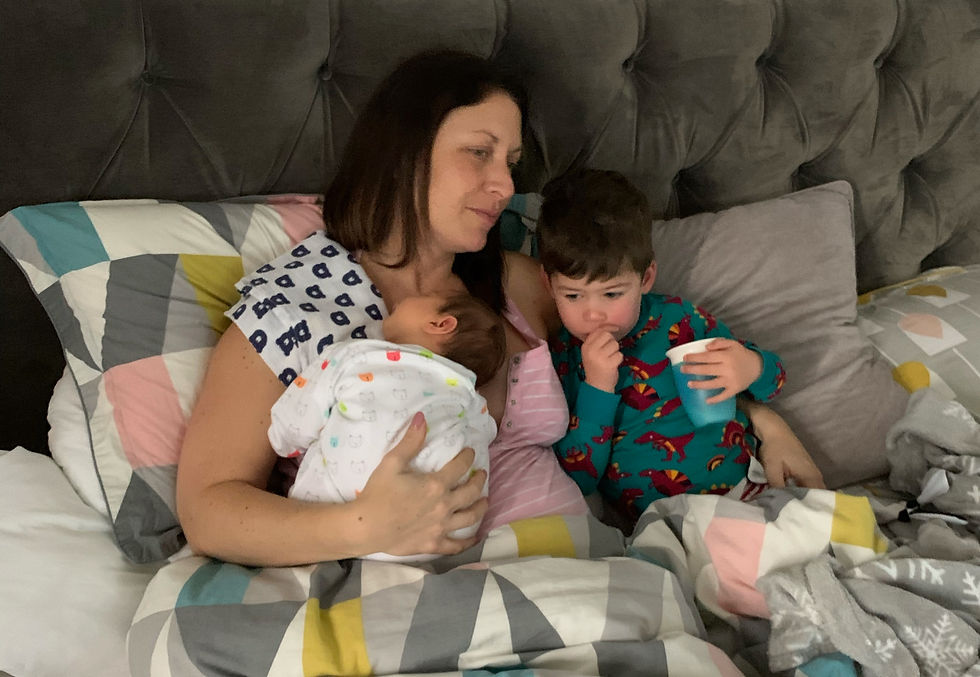
What she didn't know - what I never told her - was that part-time was all I had left to give. I was running on months of broken sleep, night after night of getting up to settle a baby who simply wouldn't stay down, doing it alone because my partner's long hours meant the nights were mine and mine only. Part-time wasn't a lifestyle choice. It was survival.

Leaving the office at 4pm while everyone else stayed on felt like a walk of shame - colleagues watching me go, the unspoken judgement following me out the door. And the guilt didn't stop there. I felt guilty for not being fully present at work. I felt guilty for leaving my baby with someone else four days a week so I could earn a living. I felt stretched so thin between two identities that neither one felt like it was getting the best of me.
For years, my partner only really got the frazzled, impatient, running-on-empty version of me. Not because I didn't love him. Because there was nothing left.
I know my story is far from unique. I know that right now, there's a working mother reading this who feels exactly the same pull, the same guilt, the same bone-deep exhaustion. And I suspect most managers and business leaders have no real idea to what extent this is affecting their own teams - because most of us never say a word. We just quietly get side-lined, or quietly burn out, or quietly leave.

Sleep deprivation and working parents: this isn't a niche problem
Here's the scale of what we're talking about: three in four mothers with dependent children are in work in the UK, and over 90% of fathers are too. This isn't a small pocket of any workplace occasionally affected by a rough night. This is the overwhelming majority of working parents in the UK, at some point, navigating this exact experience.
And it isn't a fleeting, six-week newborn phase either. A UK study by Bounty (2025–2026) found:
82% of parents experience frequent night wakings well beyond the newborn stage
72% say sleep deprivation harms their mental health
47% say it's worse than they ever expected
45% report anxiety or depression linked directly to sleep deprivation
55% of respondents were still navigating this well past the 12-month mark, with sleep disruption and frequent night wakings continuing long after the newborn stage
Read that last figure again.
More than half of the parents surveyed were still in it a full year on. This is the reality of sleep deprivation for working parents - a sustained, workforce-wide drain on some of the most experienced, hardest-working people in any organisation.
The business case for employee wellbeing benefits isn't emotional - it's measurable
"Support your employees' wellbeing" can sound like a nice sentiment without hard numbers behind it. So let's look at the numbers.
A 2024 longitudinal study published in Healthcare (Basel) found that declines in sleep quality and sleep duration were directly associated with increased sickness absence among working adults. In plain terms: people running on poor sleep are taking measurably more sick days, and the data shows a direct line between the two - a pattern that maps closely onto what sleep-deprived parents experience.
A 2023 systematic review in PharmacoEconomics reinforced this, concluding that sleep problems among employees are linked to higher absenteeism and increased costs for employers. This isn't a soft wellbeing metric - it's a line item.
And large-scale workforce data shows that employees with poor sleep quality have more than double the unplanned absenteeism rate of their well-rested colleagues.
Put all of this together with the fact that over 70% of UK parents say sleep deprivation is harming their mental health, and more than 80% are dealing with multiple night wakings long after the "expected" newborn window - and the picture becomes impossible to ignore. Supporting new parents through infant sleep isn't a soft perk. It's a strategic investment in retention, performance, and the wellbeing of a huge proportion of any workforce.
"Supporting new parents through infant sleep isn't a soft perk. It's a strategic investment in retention, performance, and the wellbeing of a huge proportion of any workforce."
Katie Snell - Founder, Little Dreamers Sleep Co.

More than the bottom line: what this says about a business
Beyond the pounds and pence, there's something else at stake here - how it feels to work somewhere.
When a business offers real, practical support for something as universal and as brutal as infant sleep deprivation, it sends an unmistakable message to everyone watching: we see what our people are carrying, and we care enough to actually do something about it. That's not just good ethics. It's good business.
In a market where experienced, capable talent - particularly women returning from maternity leave - can choose carefully where they work, the businesses that genuinely support parents through this stage stand out. It becomes a real differentiator for recruitment and retention, not just a line in a policy document. People remember who showed up for them at their hardest moment. And they tell other people about it too.

So why isn't infant sleep support an employee benefit already?
Here's what stopped me in my tracks while researching this piece: I could only find two UK businesses currently offering infant sleep support as an employee benefit for new parents.
Just two.
We've normalised gym memberships, mental health apps, private healthcare, even fertility support and menopause policies as part of a modern benefits package - all genuinely valuable additions to workplace wellbeing. But the single most disruptive, universal, and measurable driver of new-parent burnout has been left completely untouched.

Why the gap?
A few reasons, I suspect:
It's been treated as a "home" problem, not a "work" problem. Sleep happens at night, in someone's house, so it's been quietly filed under "personal life" rather than recognised for what it actually is - a direct driver of workplace performance, absenteeism, and retention.
It's assumed to be short-term. Most people still think of infant sleep struggles as a "newborn thing" that resolves itself within a few months. The data tells a very different story - 55% of parents are still struggling after 12 months. This isn't a short dip that quietly sorts itself out.
It's deeply personal - and that makes it invisible to the people deciding. Employee benefits tend to get shaped by whoever's in the room when the decisions are made. And here's the uncomfortable truth: if that person isn't a parent, or is someone whose partner absorbed the brunt of the night wakes while they slept through most of it, or is a parent who simply got lucky with an easy sleeper - they have no real reference point for what this actually feels like. Sleep deprivation isn't something you can appreciate from the outside. You have to have lived inside it to understand why it's not "just tiredness." It's genuinely traumatic for a huge number of parents. And you can't build a benefit for something you've never had to survive.
Nobody's offered a scalable solution - until now. Menopause and fertility benefits have become mainstream partly because dedicated specialists and services have grown up around them, making it easy for a business to simply plug in support. Infant sleep, until now, hasn't had that same infrastructure. What's been missing is a way to support hundreds of parents at once - at a cost and scale that makes sense for a business - while still giving each one genuinely personalised coaching from a certified expert in holistic, responsive sleep support. Not a generic app. Not a one-size-fits-all PDF. Real coaching, delivered at scale. That gap is exactly why I built my sleep coaching program for working parents - because the solution needed to exist before anyone could reasonably be expected to offer it as a benefit.
And perhaps the biggest reason: "sleep training" is a loaded, uncomfortable phrase. It gets bundled up with leaving babies to cry so parents can get back to "normal life" faster - tapping into a very Western tension around whether wanting more sleep makes a parent selfish. No business wants to be seen endorsing that, so the whole topic gets avoided.
But sleep training isn't the only route to more sleep. A responsive, holistic approach - working with a baby's needs, keeping breastfeeding and connection intact, never leaving them to cry - gets the same outcome without asking anyone to choose between their baby and their career. It's exactly the approach I use with the parents I work with.
Which means, right now, there's a genuine first-mover opportunity here. The business that gets ahead of this - that becomes known as the employer who actually supports new parents through the hardest, most exhausting stretch of early parenthood - has a real opportunity to stand out, retain talent, and build a reputation as somewhere people actually want to build a career, even after having children.
How I'm helping working mums beat sleep deprivation - without sleep training

This is exactly the gap I built my work around - because I lived every part of it. I know what it's like to be exhausted, side-lined, and doubted, simply because my baby wasn't sleeping and nobody around me understood why that mattered so much.
Every working mum I've supported through my program has seen real, measurable change in overcoming sleep deprivation - not just in their baby's sleep, but in their own wellbeing, their confidence, and how they've felt stepping back into their career. That change doesn't come from a generic sleep plan. It comes from personalised, responsive support, and from being surrounded by other parents in the same boat who remind you that you're not failing - you're just exhausted, and there's a way through it.
If you're a working parent reading this and recognising every word, please know: this doesn't have to be something you white-knuckle through alone for another 12 months.
And for anyone sitting in a position to influence how their workplace supports new parents - whatever that role looks like - it's worth asking a simple question: with three in four mothers with dependent children in work, and the majority of them are quietly burning out in the background of every return-to-work story, what would it actually take to close that gap?
Not as a gesture. As infrastructure.
Because the case is no longer emotional. It's strategic. And right now, it's sitting there, completely unclaimed.


Comments